Tuesday, 19 May 2015

10 WAYS TO DISCERN RATHER THAN CONDEMN

Foolish leaders believe pointing out what went wrong inspires people to do better.

You can’t condemn and inspire at the same time.

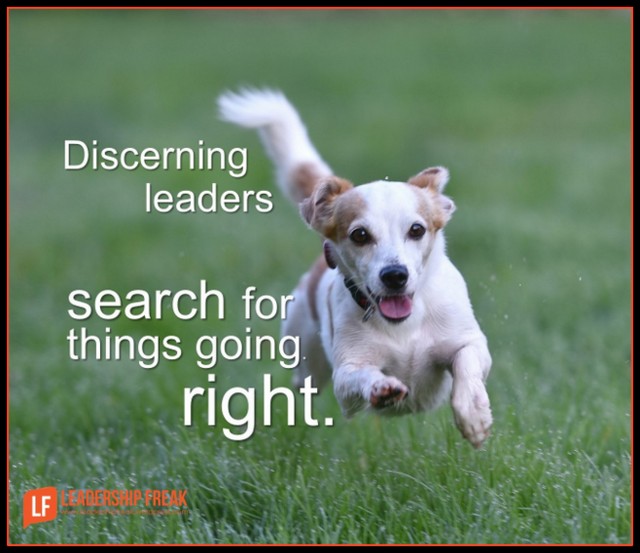
Discerning leaders hunt for things that are going right. Condemning leaders point out what went wrong.

Condemning leaders:

  1. Fixate on mistakes.
  2. Focus on shortcoming.
  3. Concentrate on failure.
  4. Obsess over faults.
The lowest form of leadership is pointing out faults after things go wrong.

4 results of condemning leadership:

  1. Dis-empowered teammates.
  2. Self-protective attitudes.
  3. Fear of failure..
  4. Low energy environments.
Fault-finding is the easy side of discernment. It doesn’t take much to explain what should have been done.
Discerning leaders search for excellence. Condemning leaders find fault.
The highest form of leadership is maximizing potential.

10 ways to be a discerning leader:

  1. Evaluate to find the good. Anyone can point out the bad.
  2. Analyze what works.
  3. Search for what is useful.
  4. Actively show approval of behaviors that matter.
  5. Search for useful behaviors to repeat.
  6. Seek positive tipping points. Discerning leaders dig into successes to uncover simple key factors that makes things work.
  7. Use purpose to highlight behaviors that matter.
  8. Make reaching goals easier. Ask your teams how you can help them succeed.
  9. Engage in behaviors and say words that increase energy in others.
  10. See the best in people.

Discerning leaders confront when:

  1. Shared values are violated, as long as those values are clearly known before hand.
  2. Behaviors fall short, as long as expectations were clear from the beginning.
  3. Goals aren’t reached, as long as people are equipped and qualified.
Discerning leaders maximize success by taking action before things go wrong. Condemning leaders set expectations after things go wrong.

Friday, 15 May 2015

7 WAYS TO PUT IN MORE THAN YOU TAKE OUT

A great Post by Dan Rockwell


You’re a black hole, if all you think about is what you need from others.
Great leaders give more than they take.
great leaders give more than they take

4 things that drain people:

  1. Expectation without appreciation. You aren’t thankful for behaviors you expect. “We don’t thank people for doing their job.”
  2. Direction without respect. “I don’t care what you have to do, just get it done.”
  3. Nit-picking without honoring hard work.
  4. Showing up when there are problems but not celebrating successes. “Seagull managers fly in, make a lot of noise, dump on everyone, then fly out.” Ken Blanchard.
Energizing goes beyond paychecks and plaques.

7 ways to put in more than you take out:

  1. Make a list of ways you can pour into your teammates. Engage in at least one act of free generosity every day.
  2. Agree on what matters today, tomorrow, and next week. People want to do what matters. In order to succeed at what matters, you must first know what matters.
  3. Learn from others. “What do you think?”
  4. Hold yourself and others to high standards with tenacity and kindness. Define and reach for high standards together.
  5. Lead with heart. Connect results to purpose. Explain how they’re making things better in view of organizational purpose. “When you open a door for a customer, you take us where we want to go,” for example.
  6. Focus on solutions more than problems. Examine problems long enough to understand them, but focus on making things better. When things go wrong, ask:
    • What are we learning?
    • What do we need to stop doing?
    • What will you do differently next time?
  7. Make people feel important. If you don’t know what makes people feel important, ask, “What makes you feel important?”
Bonus: Forgive sincere failure. Confront negligence. Give second chances.
How might leaders learn to give more than they take?

Thursday, 26 February 2015

HOW TO STOP TELLING PEOPLE WHAT TO DO


Traditional managers expect compliance. Coaching-managers expect engagement, creativity, responsibility, and ownership.

People who have been controlled often prefer compliance over participation.
“Just tell me what to do,” is a cop out.

Some prefer being controlled to the responsibility of controlling themselves.
It’s easier and safer to be told what to do than to figure it out yourself.

Controlling managers:
  1. Place themselves in the center.
  2. Create helplessness in others. The more compliance you expect the more helplessness you create.
  3. Enjoy giving permission.
  4. Stifle creativity.
  5. Punish mistakes.
  6. Complain about disengaged employees.
  7. Feel stress that comes from trying to control things that can’t be controlled.
Bonus: Controlling managers create bottlenecks.

Coaching managers:
  1. Place others in the center.
  2. Give power.
  3. Expect initiative.
  4. Tap creativity.
  5. Use mistakes as growth opportunities.
  6. Celebrate engagement, effort, and progress.
  7. Believe others must control themselves. Compliance isn’t engagement.
Bonus: Coaching-managers enhance the results of others.

Overcoming resistance:
Transitioning from controlling management to coaching feels awkward to employees.
What if an employee says, “You have more experience. Just tell me what to do.”
How to coach through resistance to being coached:
  1. What feels good about having me tell you what to do?
  2. How might developing your own solutions be useful?
  3. What would you suggest we try? Be sure several options are on the table before they choose a path forward.
  4. Which option energizes you?
  5. How can you take the next steps?
  6. Your development is more important than taking the quick way.
  7. We’re different people, what works for me may not work for you.
Not always:
Coaching isn’t a cure all. The choice to tell or advise is still on the table.
The ultimate goal of coaching is developing and leveraging the potential of others. But, sometimes the need for quick results takes precedence over development.


Monday, 2 February 2015

The Artist

   
A great Post by John Fischer   
You've heard the story of the young kindergartener who, when asked by her teacher what she was going to create for her art project proudly announced she was going to draw a picture of God. To which the teacher announced, "But no one knows what God looks like."

"They will in a minute," came the bold reply.

Perhaps I like this so much because it reminds me of my own daughter, who, at about the same age, when confronted by the teacher about using her brush improperly, replied, "Well, I'm the artist!"

Their both right, you know. The kindergartner is about to paint what God looks like to her, in her imagination, and she will be right because she is the artist. Not that God is relative to everyone's idea of Him, but that He is so multifaceted that no one picture can capture all of Him, nor can all of the pictures together make Him up. It is the picture painted by all of us that brings Him great glory. That's why He made us.

Think on this today: We bring God to people, not only because are we are in His image, but because He dwells in us by faith.

What I love most assuredly about these statement is the audacity with which they are delivered. "Oh, they'll know all right, because I am about to reveal Him to them," and, as Anne said, in case there's any doubt, "I'm the artist." Would that we were all as confident about our ability to represent Christ to the world. You can be, you know, because you are the artist.

This was a major part of Christ's role while on earth-to represent God to the world. "He who has seen me has seen the Father."

Our task is no less significant. If part of Jesus' purpose was to reveal God to us, part of ours is to reveal Jesus to others. "Christ in you, the hope of glory," Paul wrote.

What a great thing to focus on as we prepare to do anything -- go anywhere -- see anybody... "No one knows what God looks like?" we can say to ourselves, "But they will in a minute... because I'm the artist."


Tuesday, 16 December 2014

The real priority of leadership: Humility

Humble leadership in practice

  1. Judge people by their strengths, not yours.
  2. Understand that success depends on understanding, releasing, focusing and developing talent in others.
  3. Know yourself through habitual self-reflection.
  4. Understand how others perceive you. A disconnect between the way you see yourself and others see you indicates lack of self-awareness.
  5. Thank people when they share their insights and provide feedback. Painful feedback is good.
  6. Expect people to be their best. The guiding term is “their” best.
  7. Create environments that nurture and protect excellence. Expect the most from yourself.
Bonus: The uncomfortable truth of surrounding yourself with people who are smarter than you is you become the dumbest person at the table, unless you’re a know it all.

Monday, 8 December 2014

12 Ways to Move From Powerless to Powerful

A great post by Dan Rockwell.

Frustration is connected to feeling powerless. You wouldn’t be angry if you had the power to change it.
People who feel powerless respond with frustration to opportunity, difficulty, challenge and uncertainty.

Power:

Power is the ability to change something.
Even weak people have power.
Weak people use dark-power to make things worse.

fireworks with red backgroundDark-power:

  1. Backstabbing.
  2. Undermining.
  3. Gossip.
  4. Distracting and diluting focus.
  5. Pulling back.
  6. Deception.
  7. Sabotage.
Successful leaders use power to make things better.

12 ways to move from powerless to powerful:

  1. Say yes selectively. How will saying yes move you and your organization forward. If you aren’t sure, say no.
  2. Learn to say no with compassion, but don’t come off angry, resistant, or reluctant. Say no to activities that collide with your values, priorities, mission, and vision. If you’re saying no to indulge yourself you’re losing power not gaining it.
  3. Focus on things within your control – yourself, your responses, and your immediate environment. Ask, “Can we control this,” if not, let it go and move on.
  4. Be grateful when others serve you. Gratitude increases your power and empowers others.
  5. Expect people on the team to step up. When they don’t, encourage, reassign, marginalize, or replace them.
  6. Talk about tough stuff. Just bring it up, compassionately.
  7. Say what you really think, kindly. Pretending drains power.
  8. Believe you can make something better. Power is part perception. If you were powerful, how would you act? Act that way.
  9. Find a new channel of service. Make the lives of others better. Solve a problem.
  10. Relax. Frantic thoughts and frazzled emotions move you toward powerlessness.
  11. See strength in others, but don’t minimize your own.
  12. Just move toward better. Don’t fix everything.
How can leaders help others move toward feeling powerful?

What do you do when you start to feel powerless?